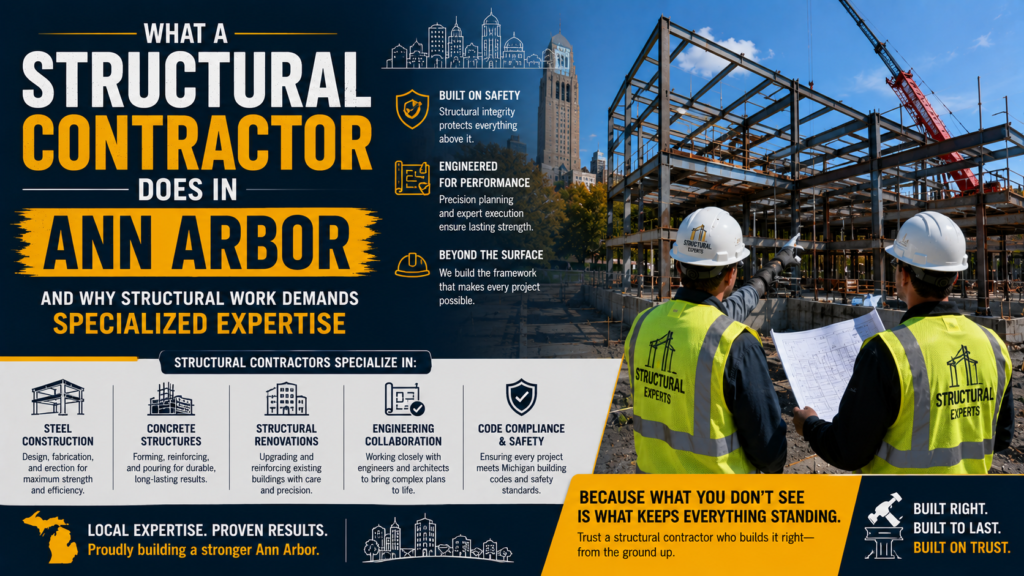
Every building stands because of a set of structural systems working together foundations bearing loads from the earth, walls and columns transmitting those loads downward, beams and joists spanning between supports and carrying floors and roofs. When those systems are working correctly, they are invisible. When they are compromised, modified, or need to be removed, specialized knowledge and skill become essential. That is what a Structural Contractor Ann Arbor provides: the expertise to work on the load-bearing elements of a building safely and correctly, whether the work involves repairing deteriorating structure, removing elements as part of demolition, or shoring up existing structure to enable other work.
In Ann Arbor, where the housing stock ranges from century-old historic homes to modern commercial and institutional structures, and where Michigan’s climate creates ongoing challenges for foundations and structural elements, the need for competent structural contracting is consistent and significant.
What Structural Contractors Do
A structural contractor specializes in the physical components of a building that carry and transfer loads. This work is distinct from finish work, mechanical systems, or site work it addresses the skeleton of the building, and errors in structural work have consequences that errors in other trades do not.
Structural work encompasses several categories. Foundation work involves the below-grade elements that transfer building loads to the soil footings, foundation walls, piers, and grade beams. Ann Arbor’s climate demands foundations built below the frost line to prevent frost heave, and the region’s clay-heavy soils create conditions that can cause foundation movement over time. A structural contractor addressing foundation issues must understand not only how to repair the damaged elements but how the soil conditions and drainage contributed to the problem in the first place.
Load-bearing wall work involves identifying, modifying, or removing walls that carry structural loads from floors or roofs above. In residential renovation a major category of work in Ann Arbor’s dense historic neighborhoods load-bearing wall removal to open floor plans is one of the most common structural interventions. Done incorrectly, removing a load-bearing wall without adequate replacement support can cause immediate structural distress or long-term settlement. A structural contractor uses beam and column installations to redistribute loads before and during wall removal, ensuring the structure above remains supported throughout the process.
Structural shoring is the temporary or permanent installation of supports to hold structural elements in position while other work occurs around them. During demolition of structures adjacent to retained elements, during foundation work beneath an existing building, or during renovation where structural elements are temporarily weakened, shoring prevents movement and collapse. Shoring design is engineering work; installing it is structural contractor work.
Structural repair addresses deteriorated, damaged, or inadequately designed structural elements. In Ann Arbor’s older housing stock, common issues include: timber beam rot from chronic moisture exposure, particularly in basements and crawl spaces; foundation wall cracking from freeze-thaw cycling and hydrostatic pressure; structural inadequacy in additions that were built without appropriate permits or engineering oversight; and settlement-related damage from soil movement. Each of these conditions requires diagnosis understanding why the element failed, not just what failed followed by repair that addresses the cause as well as the symptom.
Ann Arbor’s Structural Challenges
Ann Arbor’s architectural and geological context creates a specific set of challenges for structural contractors. The city’s housing stock includes a significant proportion of homes built in the early to mid-20th century, when building codes were different, materials were different, and construction practices that are no longer accepted were routine. Older homes in neighborhoods like Burns Park, Kerrytown, and the Old West Side frequently have timber foundations, undersized structural members, or additions built without engineering input that create structural discontinuities.
Michigan’s climate imposes severe cyclical stress on structural systems. The freeze-thaw cycle which can move through dozens of cycles per winter season in southeastern Michigan causes moisture to expand as it freezes within cracks in concrete and masonry, progressively widening those cracks with each cycle. Foundation walls in Ann Arbor basements commonly develop horizontal cracking under the lateral pressure of saturated clay soil, and vertical cracking from differential settlement is also prevalent. These conditions are not unusual; they are the predictable consequence of the region’s geology and climate acting on structures over decades.
The University of Michigan’s institutional presence, combined with Ann Arbor’s robust commercial sector, creates structural contracting demand beyond residential work. University facilities maintenance, downtown commercial renovation, and the conversion of older industrial buildings to new uses all require structural expertise applied to complex, often historically significant structures.
The Relationship Between Structural Contractors and Engineers
Structural contracting and structural engineering are distinct disciplines that work closely together. Structural engineers design solutions they perform the calculations to determine what beam size is needed to span an opening, what foundation system will adequately support a given load on a particular soil type, what shoring configuration will safely hold a structure during demolition. Structural contractors execute those designs they physically install, remove, or repair the structural elements the engineer has specified.
For straightforward work a simple beam replacement, a standard foundation crack repair a structural contractor with sufficient experience may work from general trade knowledge and established practice without a project-specific engineering document. For complex or unusual conditions a non-standard opening in an unusual structural system, a foundation repair in difficult soil conditions, a structure with unknown previous modifications a structural engineer’s design is the appropriate starting point, and the structural contractor works from that document.
In Ann Arbor, where many projects involve older structures with incomplete documentation, the collaboration between a structural engineer and an experienced structural contractor is particularly valuable. The engineer can analyze conditions and specify solutions; the contractor can flag conditions encountered during work that differ from the design assumptions. This dialogue produces better outcomes than either professional working in isolation.
Structural Work Within Demolition Projects
Structural contracting frequently intersects with demolition work, particularly on projects involving partial demolition where some elements of a building are removed while others are retained. In these scenarios, the structural contractor’s role is to identify which elements carry loads that must be temporarily or permanently redirected before removal proceeds, to install any necessary shoring, and to sequence the removal to avoid destabilizing retained structure.
In Ann Arbor, partial demolition projects are common. Historic preservation commitments in many neighborhoods require retaining facades or specific structural elements while completely rebuilding interiors. Commercial renovation projects often retain building shells while gutting interiors. These configurations require a structural contractor who can work systematically through a complex existing structure, understanding load paths and stability at each stage of the removal sequence.
What to Expect from a Structural Contractor in Ann Arbor
When you engage a structural contractor in Ann Arbor for any meaningful work, the process should begin with a thorough site assessment. For residential structural repairs, this means an experienced eye examining the foundation, structural walls, floor systems, and any areas of concern not a brief look and a quick quote. Structural conditions are often more complex than they initially appear, and a contractor who underestimates the scope of a structural problem will encounter difficulty mid-project.
Licensing matters in structural work. Michigan requires contractors to hold appropriate licenses for the work they perform, and structural work often falls under categories that require specific credentials. Asking a structural contractor for their license information and verifying it with the Michigan Department of Licensing and Regulatory Affairs (LARA) is appropriate due diligence.
Communication throughout the project is particularly important in structural work because conditions encountered during construction may differ from initial assessments. A structural contractor who keeps you informed when they find something unexpected additional deterioration behind a wall, different soil conditions than anticipated, evidence of previous repairs that affect the planned scope and who explains how they are adapting the plan accordingly is a contractor operating with the transparency that this high-stakes work requires.
Conclusion
Structural contracting in Ann Arbor addresses the most consequential elements of the built environment the systems that keep buildings standing, safe, and functional. Whether the need is foundation repair in an aging home, load-bearing wall modification during renovation, structural shoring during demolition, or assessment and correction of structural deficiencies in a historic building, the expertise of a structural contractor with genuine knowledge of Ann Arbor’s buildings and Michigan’s conditions is what makes the difference between a safe, lasting outcome and one that creates more problems than it solves.